
Every room described here sits on the regular museum routes – no special tour required. This page walks through them one by one, from the Upper Belvedere’s entrance to the Gold Cabinet of the Lower.
Upper Belvedere: the sequence
The Upper Belvedere was built as a palace of festivities – nobody lived here in Eugene’s day. Its interior is a sequence of entrances: you come in at garden level, ascend the grand staircase and reach the Marble Hall on the piano nobile. The museum rooms either side were once apartments and galleries.
The sequence is included in the ticket; there is no separate “state-room tour”, because the art hangs in precisely these rooms. Which works hang where: paintings at the Belvedere.
Sala Terrena: four atlantes
The ground-floor entrance is one of Vienna’s most powerful rooms: four colossal stone atlantes shoulder the vault of the Sala Terrena. What looks like a Baroque show of strength actually is one – the hall was originally open and lighter; after structural damage around 1732 it was reinforced with the atlantes and piers.
The stucco is by Santino Bussi, the figures from Lorenzo Mattielli’s workshop. Visitors still rush past towards the staircase. Give it two minutes.
The grand staircase
The double-flight staircase to the piano nobile stages the ascent literally: stucco reliefs show scenes from the life of Alexander the Great – the Baroque cipher for Eugene himself. From the landing windows you catch the first framed view of the garden; in summer, light pours diagonally through the building.
The symmetrical view from the foot of the stairs works best with a wide angle early in the morning, before the groups arrive. Tripods aren’t allowed – rest the camera on the balustrade instead.
The Marble Hall
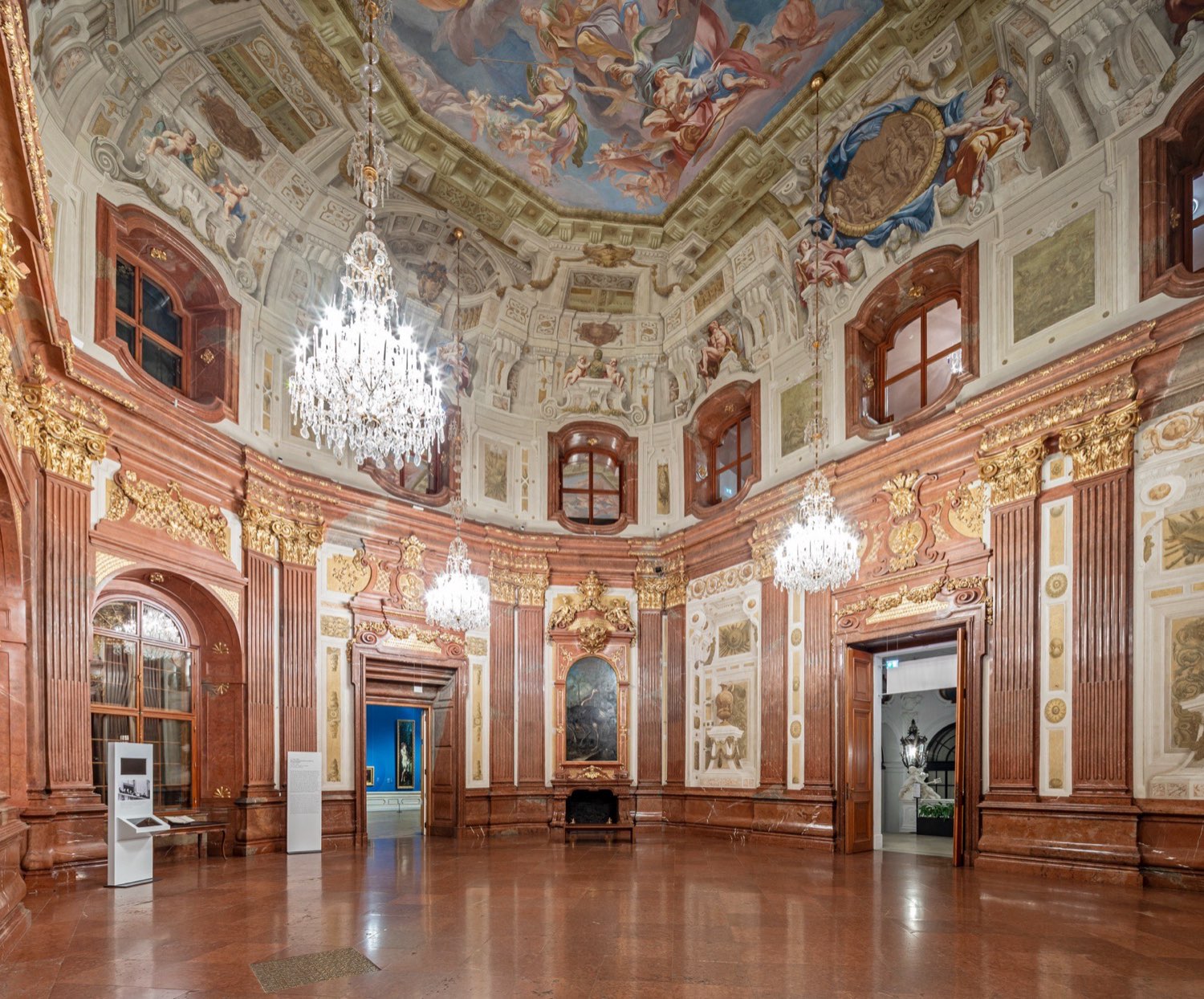
Two storeys of glory
The Marble Hall is the building’s centre: reddish-brown stucco marble, gilded capitals, and above it Carlo Innocenzo Carlone’s ceiling fresco celebrating Prince Eugene’s fame in allegory. Through the window axis, Vienna is served up on a platter – that sightline is part of the architecture.
The 1955 State Treaty was signed here; a plaque commemorates it. The hall occasionally closes for events – but most of the time it’s open and belongs on every visit.
The palace chapel
The Upper Belvedere’s chapel can be viewed from the first floor: a tall, intimate space with an altarpiece by Francesco Solimena and frescoes by Carlone. Eugene could step from his rooms straight onto the gallery. The chapel still sees occasional liturgical use; the gallery view is part of the museum route. verify gallery access
Lower Belvedere: the intimate rooms
To see how Prince Eugene actually lived, you need the Lower Belvedere – his apartments were here. Three rooms carry the visit:
- Marble Gallery – a bright festival hall with stucco reliefs and niches for antique statues; Eugene displayed his antiquities here.
- Hall of Grotesques – painted floor to ceiling with grotesques in the Roman manner: hybrid creatures, tendrils, birds. A room like a pattern book.
- Gold Cabinet – gilded panelling and mirrors up to the ceiling; the most concentrated splendour in the whole ensemble.
Access requires the Lower Belvedere ticket or the 2-in-1 combo; how prominently the rooms feature depends on the current exhibition design.
What is not accessible
- Administrative and storage areas of both palaces.
- The Marble Hall during private events (rare, mostly evenings).
- Conservation workshops – open only during special museum formats.
- Parts of the historic outbuildings such as the Orangery and the Palace Stables serve as exhibition and event spaces, open only during active programmes. check current use
Photography inside
Private photography is generally permitted in the collection areas – no flash, no tripod, no selfie stick. Temporary exhibitions often have their own rules, signposted at each entrance. Commercial photography requires the museum’s permission.
House rules per belvedere.at – check before your visit, as rules can change with exhibitions.
Frequently Asked Questions
What does the Belvedere look like inside?
The Upper Belvedere is a Baroque sequence: the Sala Terrena with four atlantes, the grand staircase and the two-storey Marble Hall – with the collection, including Klimt’s “The Kiss”, in the adjoining rooms. The Lower Belvedere holds more intimate state rooms such as the Hall of Grotesques and the Gold Cabinet.
Are the state rooms included in the normal ticket?
Yes. Marble Hall, Sala Terrena and the grand staircase are on the regular Upper Belvedere route. The Marble Gallery, Hall of Grotesques and Gold Cabinet require the Lower Belvedere ticket.
Can you take photos inside the Belvedere?
Yes, for private use without flash or tripod. Temporary exhibitions may have their own rules – watch the signs.
What is the Sala Terrena?
The Upper Belvedere’s ground-floor entrance hall, whose vault is carried by four colossal atlantes. They were added around 1732 to stabilise the structure after damage.
Where is the Gold Cabinet?
In the Lower Belvedere on Rennweg. The fully gilded mirror room belonged to Prince Eugene’s private apartments and is accessible with a Lower Belvedere ticket.
Is the Marble Hall always open to visitors?
Usually yes – it’s part of the museum route. It may close at short notice for events such as state receptions or concerts.