
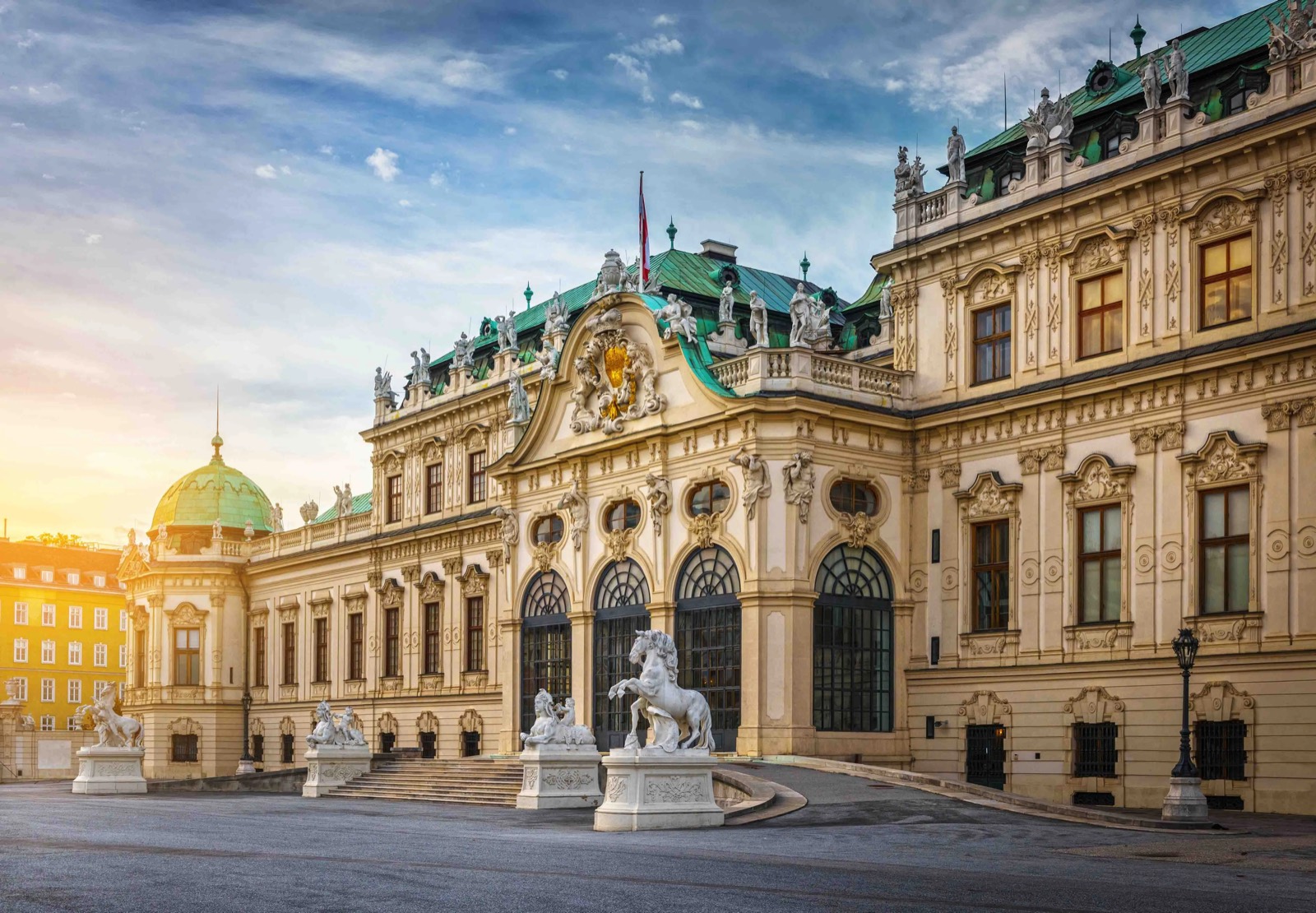
Know the building’s history and you’ll see a different palace on your visit: the grand staircase becomes a stage, the Marble Hall a venue of world politics, the garden a Baroque display of power.
Prince Eugene: the builder
Eugene of Savoy (1663–1736) was the Habsburg Empire’s most improbable success story: born in Paris, rejected by the French court, he switched to Austrian service in 1683 – just in time for the second Ottoman siege of Vienna. Over the following decades he became Europe’s most successful general and one of the richest men on the continent.
He poured his fortune into books, art and architecture. The Belvedere was built as his summer residence outside the city walls – not for governing, but for entertaining and collecting. He kept menageries of exotic animals here, cultivated rare plants and received the envoys of Europe.
The name – Italian for “beautiful view” – only came into use after Eugene’s death. The view from the Upper Belvedere across the garden to Vienna was famous already in the 18th century, and still is: Canaletto painted his celebrated Vienna vedute from here.
Hildebrandt’s double palace
Johann Lucas von Hildebrandt – alongside Fischer von Erlach the most important Baroque architect in Austria – planned not a single residence but an ensemble of two palaces linked by a garden on sloping ground.
- 1712–1716: Lower Belvedere – the residential palace on Rennweg, with Eugene’s actual living quarters, a Marble Hall for receptions and the Gold Cabinet.
- 1717–1723: Upper Belvedere – the pure showpiece on the crest of the hill, built for festivities. Almost nobody ever lived here.
- The garden – designed by the Frenchman Dominique Girard, with cascades, sphinxes and a sightline binding both palaces to the city skyline.
That division of roles explains what visitors see today: downstairs the rooms are intimate and residential; upstairs everything aims at effect – down to the Sala Terrena, whose vault rests on four stone atlantes.
From general’s seat to imperial gallery
Eugene died in 1736 without a will and without direct heirs. His niece sold the estate with its contents; in 1752 Empress Maria Theresa acquired the ensemble for the House of Habsburg.
The most consequential decision came under her son Joseph II: in 1781 the imperial picture gallery moved from the Stallburg to the Upper Belvedere and was opened to the public – making the Belvedere one of the first public museums in the world, years before the Louvre. The idea that a princely collection belongs to everyone became reality here early on.
Franz Ferdinand and Sarajevo
From 1899 Archduke Franz Ferdinand, heir to the throne, resided at the Upper Belvedere. The palace became the political hub of his “workshop” – a shadow cabinet waiting for the succession. From here he departed in June 1914 to inspect troops in Bosnia; the shots fired at him and his wife Sophie in Sarajevo triggered the First World War.
With the monarchy’s end in 1918, the Belvedere passed to the young republic – and became a museum for good.
1955: “Austria is free!”
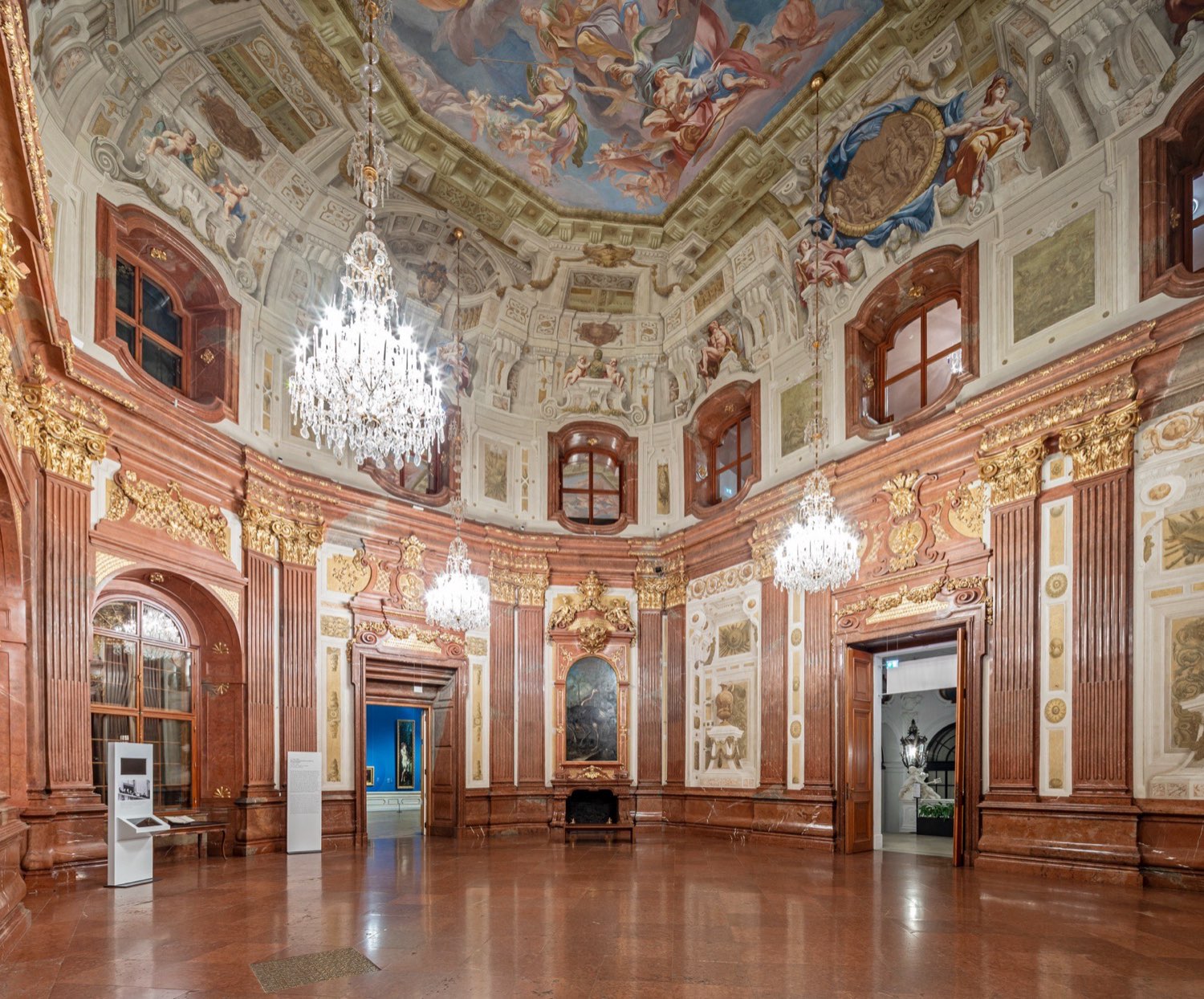
The republic’s most famous balcony line
On 15 May 1955 the foreign ministers of the four occupying powers and Austria signed the Austrian State Treaty in the Marble Hall. It ended ten years of occupation and restored full sovereignty.
Foreign minister Leopold Figl coined the phrase “Austria is free!” – spoken inside the hall, but remembered as a balcony scene when the treaty was shown to the cheering crowd in the garden. The Marble Hall is part of the regular museum route today.
From imperial house to Klimt museum
The present institution was founded in 1903 as the “Moderne Galerie” in the Lower Belvedere – championed by the Secession around Gustav Klimt, with a mandate to show Austrian art in international comparison. As early as 1908 it bought “The Kiss” straight from the Kunstschau exhibition.
- 1903 – founding of the Moderne Galerie; early purchases include Van Gogh and Segantini.
- 1918–1938 – expansion into the Österreichische Galerie covering all eras.
- 1938–1945 – the Nazi era: seizures and forced sales scar the collection; restitution work continues today – most prominently the “Golden Adele”, restituted in 2006.
- After 1945 – reconstruction of the war-damaged palaces; reopening in 1953.
- 2018 – opening of Belvedere 21 as the venue for contemporary art in Karl Schwanzer’s former World’s Fair pavilion.
Institutional history per belvedere.at.
Timeline
| Year | Event |
|---|---|
| 1663 | Eugene of Savoy born in Paris |
| 1683 | Eugene enters Austrian service; relief of Vienna |
| 1712–1716 | Lower Belvedere built (Hildebrandt) |
| 1717–1723 | Upper Belvedere built |
| 1736 | Eugene dies; the heiress sells |
| 1752 | Maria Theresa acquires the estate |
| 1781 | Imperial gallery opened to the public |
| 1899–1914 | Franz Ferdinand resides at the Upper Belvedere |
| 1903 | Moderne Galerie founded |
| 1908 | Purchase of Klimt’s “The Kiss” |
| 1955 | State Treaty signed in the Marble Hall |
| 2018 | Belvedere 21 opens |
Seeing the history on site
The history is present throughout the route once you know where to look:
- Marble Hall (1st floor) – the State Treaty; the ceiling fresco celebrates Eugene’s fame.
- Sala Terrena (ground floor) – the atlantes were inserted after structural damage in 1732; Baroque meets engineering.
- Grand staircase – reliefs with scenes from Eugene’s campaigns.
- The garden axis – from the upper terrace, Hildebrandt’s staging clicks into place: city, garden and palaces in one line.
- Palace chapel – visible from the first floor, altarpiece by Francesco Solimena.
How the rooms look today and what the ticket covers: inside the Belvedere. The architectural walkthrough: Upper Belvedere.
Frequently Asked Questions
Who built Belvedere Palace?
Prince Eugene of Savoy commissioned it; the architect was Johann Lucas von Hildebrandt. The Lower Belvedere rose in 1712–1716, the Upper Belvedere in 1717–1723.
Did an emperor ever live at the Belvedere?
The Belvedere was never an imperial residence. After Maria Theresa bought it in 1752 it served mainly as a gallery. Heir apparent Franz Ferdinand resided at the Upper Belvedere from 1899 – the most prominent occupant after Prince Eugene.
What is the Austrian State Treaty and why was it signed at the Belvedere?
The 1955 State Treaty ended the post-war occupation and restored Austria’s sovereignty. It was signed on 15 May 1955 in the Marble Hall of the Upper Belvedere – the republic’s most ceremonial room.
How long has the Belvedere been a museum?
Since 1781, when Joseph II opened the imperial picture gallery at the Upper Belvedere to the public – making it one of the world’s oldest public museums.
Where does the name “Belvedere” come from?
From Italian: “beautiful view”. It refers to the outlook from the Upper Belvedere across the garden to Vienna’s old town, famous since the 18th century.
What connects Franz Ferdinand to the Belvedere?
The heir to the throne lived at the Upper Belvedere from 1899 and ran his political operation from here. In 1914 he departed from Vienna for Sarajevo, where his assassination triggered the First World War.