
The Österreichische Galerie Belvedere has collected for over a century with a clear profile: Austrian art in international context. The result is not an encyclopaedia like the Louvre but a concentrated museum you can genuinely see in two hours.
The priority list
If time is short, here is the collection as a ranking – subjective, but road-tested:
- “The Kiss” and the Klimt rooms (2nd floor) – the reason most people come, and rightly so.
- Egon Schiele: “The Family” and “Death and the Maiden” (2nd floor) – the dark answer to Klimt’s gold.
- Messerschmidt’s Character Heads (ground floor) – 18th century, feels like contemporary art.
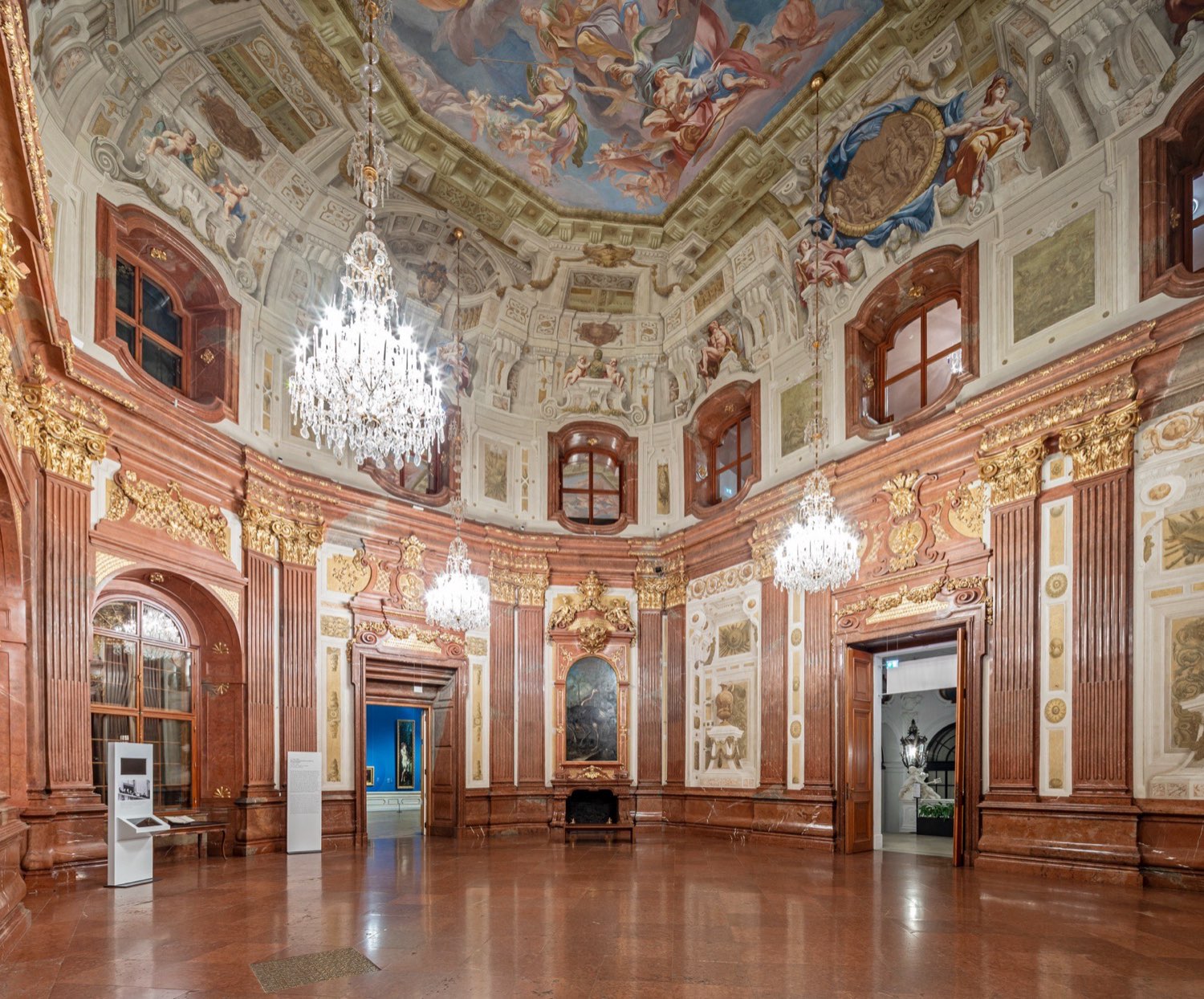
- The Marble Hall (1st floor) – not a painting, but you don’t skip it.
- Biedermeier: Waldmüller (1st floor) – light that looks painted yesterday, made around 1830.
- French modernism: Monet, Van Gogh (1st floor) – compact but first-rate.
- The medieval rooms (ground floor) – a quiet high point for fans of Gothic panel painting.
The Belvedere rearranges regularly. Individual works may be in restoration, on loan or in another room. The floor plan at the entrance always has the final word.
Vienna 1900: Klimt, Schiele, Kokoschka
The second floor is the heart of the museum. Around 1900 Vienna was modernism’s laboratory – Freud, Mahler, Loos – and in the middle of it three painters whose works now hang side by side.
- Gustav Klimt – beyond “The Kiss”: “Judith”, society portraits and the Attersee landscapes. Details and the best visiting hour: Klimt guide.
- Egon Schiele – “The Family” was painted in 1918, the year he died at 28; “Death and the Maiden” is considered his most personal work. Nervous line instead of ornament.
- Oskar Kokoschka – expressive portraits whose sitters look older than they were. Kokoschka called it painting “the inside out”.
Want to go deeper? The audio guide covers Vienna 1900 most thoroughly – its €5 pay off in these rooms above all.
The 19th century: Biedermeier to Impressionism
The first floor tells the century before. Three names structure the walk:
- Ferdinand Georg Waldmüller – master of the Biedermeier: razor-sharp light, scenes of daily life, roses. His landscapes anticipate open-air painting.
- Hans Makart – Vienna’s salon prince of the Gründerzeit, huge formats, theatrical colour. An entire interior style bears his name.
- Jakob and Rudolf von Alt – vedute documenting Vienna before the Ringstraße rebuild; a treasure for city-history fans.
Messerschmidt’s Character Heads
The strangest heads of the 18th century
Franz Xaver Messerschmidt, a court sculptor whose career derailed, began a series of grimacing self-portrait busts in lead and alabaster around 1770 – pressed lips, screwed-shut eyes, an extreme yawn. Art history still debates whether they reflect a study system, superstition or a psychological crisis.
A selection of these “Character Heads” stands on the ground floor of the Upper Belvedere. They are the museum’s most reliable surprise hit – especially with visitors who came “only for Klimt”, and with children.
Medieval and Baroque art
The collection reaches back to the 12th century. Two holdings justify the detour to the ground floor:
- Gothic panel painting and carved altarpieces – including the 15th-century Znaim Altarpiece, a principal work of the late Gothic.
- Baroque: Maulbertsch, Rottmayr, Troger – the generation that painted Austria’s churches and abbeys, here in cabinet format.
These rooms stay calm even at midday – a good buffer when the upper floors are at peak traffic.
International guests: Monet, Van Gogh, Renoir
The French section is small but weighty: Monet’s garden at Giverny, a Van Gogh plain from Auvers, plus Renoir. These works entered the collection early – from 1903 the museum deliberately bought international modernism to show Austrian art in comparison. That comparison is exactly what makes the visit productive: look at Monet first, then Klimt’s Attersee paintings – the kinship is startling.
Collection history per belvedere.at. Individual works may be on loan or in storage.
Three routes by interest
| Profile | Route | Time |
|---|---|---|
| Icons only | 2nd floor (Klimt, Schiele) → Marble Hall → exit | 60 min |
| Art history compact | Ground floor (medieval, Messerschmidt) → 1st floor (19th c., French) → 2nd floor (Modernism) | 2 hrs |
| With children | Character Heads → grand staircase → “The Kiss” → garden | 75 min |
Frequently Asked Questions
Which famous paintings are at the Belvedere?
The best-known works are Gustav Klimt’s “The Kiss” and “Judith”, Egon Schiele’s “The Family” and “Death and the Maiden”, works by Oskar Kokoschka and Ferdinand Georg Waldmüller, and paintings by Monet, Van Gogh and Renoir – plus Messerschmidt’s Character Heads in sculpture.
Are all paintings included in the standard ticket?
Yes. The Upper Belvedere’s permanent collection is fully covered by the venue ticket. Only temporary exhibitions at the Lower Belvedere and Belvedere 21 have separate tickets.
Are Van Gogh and Monet really at the Belvedere?
Yes – the Belvedere owns a small collection of French modernism including Monet, Van Gogh and Renoir, usually on the first upper floor. Individual works may occasionally be on loan.
What are Messerschmidt’s Character Heads?
A series of grimacing self-portrait busts by sculptor Franz Xaver Messerschmidt from the late 18th century, cast in lead and carved in alabaster. A selection stands on the Upper Belvedere’s ground floor.
How old is the Belvedere collection?
It spans roughly 800 years – from 12th-century panel painting to contemporary art at Belvedere 21. The gallery itself was founded in 1903 as the Moderne Galerie.
Can you see Schiele at the Belvedere?
Yes – the Belvedere shows central works by Egon Schiele, including “The Family” and “Death and the Maiden”, on the second floor beside the Klimt rooms.